
कर्मण्येवाधिकारस्ते मा फलेषु कदाचन
Karma Yoga
The path of selfless action. Perform your duty without attachment to results. This frees you from the cycle of cause and effect.
— THE DIVINE TEACHER —
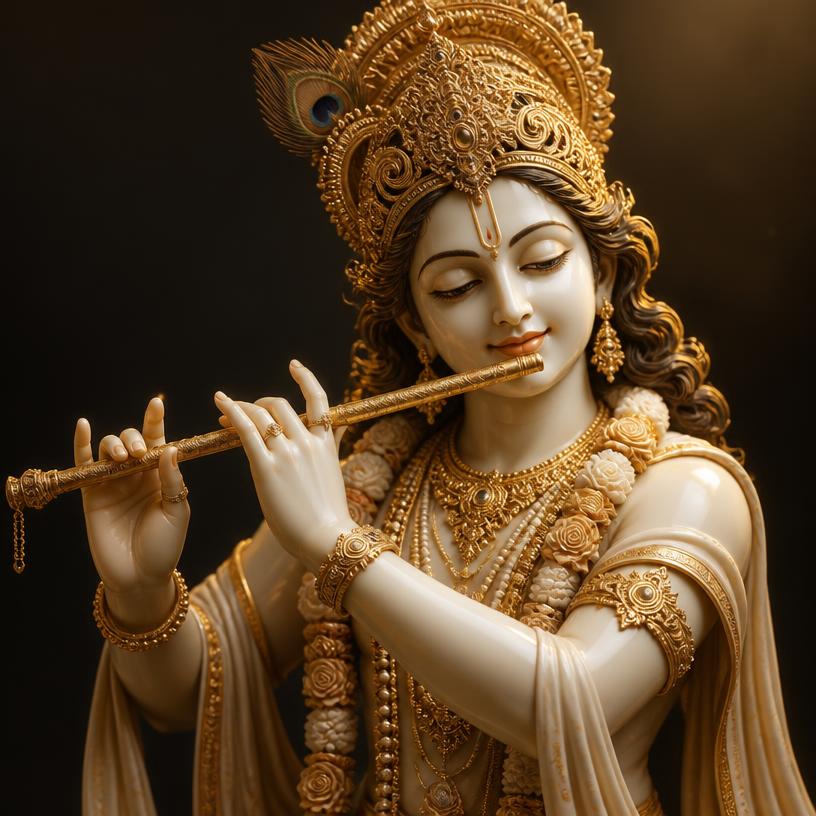
The Supreme personality of Godhead, the divine teacher of the Bhagavad Gita, whose timeless wisdom continues to guide millions toward spiritual realization and inner peace.
— WHO IS LORD KRISHNA —
Lord Krishna is the eighth avatar of Vishnu and one of the most revered deities in Hinduism. Born in Mathura over 5,000 years ago, his life story — from his enchanting childhood in Vrindavan to his role as Arjuna's charioteer at Kurukshetra — represents the complete spectrum of divine play.
Krishna is not merely a historical or mythological figure. He is the complete incarnation of the Supreme Being, exhibiting all six divine opulences: wealth, strength, fame, beauty, knowledge, and renunciation. His teachings in the Bhagavad Gita form the essence of Vedic philosophy and spiritual practice.
The name Krishna means "the all-attractive one." Through his life and teachings, he demonstrates how to live a life of purpose, joy, and spiritual fulfillment while engaging fully in the world.
— THE BHAGAVAD GITA —
The Bhagavad Gita is a 700-verse dialogue between Lord Krishna and the warrior Arjuna on the battlefield of Kurukshetra. It is the core spiritual text of Hinduism — a universal guide to life, duty, and liberation.
— CORE TEACHINGS —
Krishna taught four distinct yet interconnected paths to spiritual realization.
कर्मण्येवाधिकारस्ते मा फलेषु कदाचन
The path of selfless action. Perform your duty without attachment to results. This frees you from the cycle of cause and effect.
नैनं छिद्रन्ति शस्त्राणि नैनं दहति पावकः
The path of knowledge. Understand the eternal nature of the soul — it is never born, never dies, and transcends the physical body.
सततं कीर्तयन्तो मां यतन्तश्च दृढव्रताः
The path of devotion. Surrender to the divine with unwavering love. True devotion transcends ritual and connects the soul directly to God.
योगस्थः कुरु कर्माणि सङ्गं त्यक्त्वा धनञ्जय
The path of meditation. Still the mind, control the senses, and realize the self through disciplined practice and inner focus.
— SACRED SHLOKAS —
कर्मण्येवाधिकारस्ते मा फलेषु कदाचन ।
मा कर्मफलहेतुर्भूर्मा ते सङ्गोऽस्त्वकर्मणि ॥
You have a right to perform your prescribed duties, but you are not entitled to the fruits of your actions. Never consider yourself the cause of the results of your activities, and never be attached to not doing your duty.
— Bhagavad Gita 2.47
यदा यदा हि धर्मस्य ग्लानिर्भवति भारत ।
अभ्युत्थानमधर्मस्य तदात्मानं सृजाम्यहम् ॥
Whenever there is a decline in righteousness and an increase in unrighteousness, O Arjuna, at that time I manifest Myself on earth.
— Bhagavad Gita 4.7
न जायते म्रियते वा कदाचिन्
नायं भूत्वा भविता वा न भूयः ।
अजो नित्यः शाश्वतोऽयं पुराणो
न हन्यते हन्यमाने शरीरे ॥
The soul is never born nor does it ever die. It is unborn, eternal, everlasting and primeval. It is not slain when the body is slain.
— Bhagavad Gita 2.20
योगस्थः कुरु कर्माणि सङ्गं त्यक्त्वा धनञ्जय ।
सिद्ध्यसिद्ध्योः समो भूत्वा समत्वं योग उच्यते ॥
Be steadfast in yoga, O Arjuna. Perform your duty and abandon all attachments to success or failure. Such evenness of mind is called yoga.
— Bhagavad Gita 2.48
— TIMELESS WISDOM —
In an age of anxiety, burnout, and spiritual emptiness, Krishna's message of detached action, emotional mastery, and inner peace has never been more relevant. The Gita offers practical tools for modern living — from stress management to ethical leadership.
Meditation and mindfulness practices rooted in Krishna's Dhyana Yoga.
Freedom from anxiety through detachment from outcomes and desires.
Discover your true calling and live a life aligned with your highest nature.
Join our Bhagavad Gita study group and transform your life through Krishna's wisdom.
JOIN THE STUDY